How Long Does It Take to Get German Citizenship in 2026?
Expect roughly a year to eighteen months from application to naturalization certificate in a large German city in 2026, and longer in some. Munich reports eighteen months or longer, and Hamburg reports more than fourteen months. Berlin gives no forecast for its oldest cases. Some smaller authorities decide within months, so your postcode matters more than your paperwork.
There is no national timeline. Each local naturalization authority (Einbürgerungsbehörde) sets its own pace, and 2026 has made the gaps wider. A May 2026 survey of the 50 largest cities reported more than a year in almost all of them and more than two years in about half.
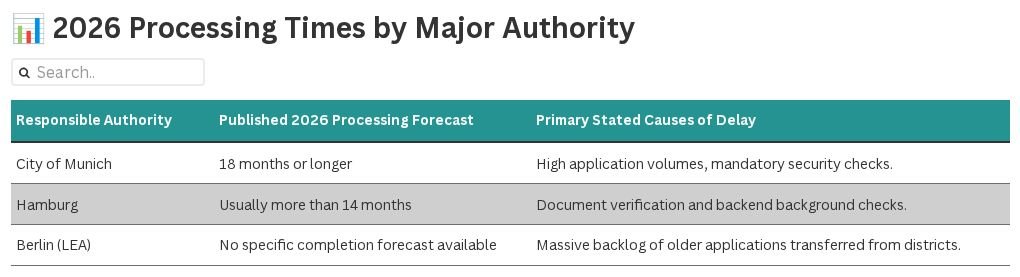
📊 2026 processing times by major authority
The table shows what three of the biggest authorities say about themselves. Read it row by row.
The City of Munich forecasts eighteen months or longer. It names high application volumes and the mandatory security checks as the reasons.
Hamburg says the process usually takes more than fourteen months. Its stated causes are document verification and background checks running behind the application.
Berlin’s State Office for Immigration (LEA) gives no specific completion forecast. That statement covers the older applications the LEA inherited from the districts when it took over in January 2024, roughly 40,000 of them, and it does not describe every new Berlin case. Independent trackers built from applicants’ reports put recent Berlin cases at around ten months. That is anecdotal evidence, so treat it as a hint and not a promise.
The long part, whichever authority you fall under, is the security phase. Federal databases are queried, and a caseworker cannot skip that step however tidy your file is.
🌍 The 2026 European naturalization landscape
The second chart puts Germany’s clock beside ten other countries, and the processing time above comes on top of every bar.
Germany, France, the Netherlands and Ireland sit at five years. Greece asks for seven and Sweden for eight. Spain, Italy, Switzerland and Portugal all ask for ten.
Two of those bars moved this year. Portugal lengthened its requirement to ten years in May 2026, and Sweden raised its requirement from five years to eight on 6 June 2026. The Netherlands has a proposal on the table to double its five-year rule to ten, though it has not become law and five years still applies. These are headline periods, and each country has shorter routes for spouses and a few other groups.
So Germany’s five years plus about a year of processing still leaves it ahead of most of Europe, though it ties with three other countries on the clock itself.
⏳ 1. The three-month lawsuit
Forums talk about a “three-month rule” as if it entitled you to a passport after 90 days. It does not. Section 75 of the administrative court procedure code (VwGO) lets you file an action for failure to act (Untätigkeitsklage) if the authority has not decided within a reasonable time and has no sufficient reason, and the court will not usually hear it before three months have passed.
The reasoning cuts both ways. If the authority shows a sufficient reason for the delay, the court suspends the court case until a deadline it sets, and your application keeps moving through the queue in the meantime. Whether a heavy backlog counts as sufficient reason varies by court, and some lawyers report that Berlin judges treat waits beyond about ten months as the authority’s responsibility. A lawsuit adds legal costs, and it can prompt a decision without guaranteeing a quick one. Speak to a lawyer before you file.
🎯 2. What you can control
You cannot hurry the security checks, but you can avoid the delays that come from a file with holes in it. A request for a missing document usually means weeks or months of extra waiting, so assemble everything before you apply. That means your B1 certificate, your Einbürgerungstest result, translations of your civil documents, and recent payslips. Berlin’s checklist asks for six months of payslips, so check what your own authority wants.
Apply through the online portal where your municipality offers one, since Munich now requires online applications and Berlin runs its process through the LEA portal. Large authorities rarely answer status enquiries, and Berlin’s LEA generally does not, though Munich has said it plans to update applicants every three months.
If you move to another municipality mid-process, your file has to move with you, and that can add delay.
✅ Advantages
Germany’s five-year baseline remains shorter than Portugal, Sweden, Italy and Spain, even after the three-year fast-track was repealed in October 2025.
Germany no longer asks you to renounce your previous citizenship first, which removes a step that once held up applicants from countries like India. India itself does not allow dual citizenship, so Indian applicants still surrender their citizenship after naturalizing.
⚠️ Disadvantages
The postcode lottery is real. Some smaller authorities decide in a few months, while large cities run past a year, and applicants with identical profiles can wait very differently.
Communication is thin. You may wait over a year with little more than an acknowledgement.
🎯 Right for and 🚫 wrong for
Right for applicants who file a complete dossier as soon as they meet the requirements, hold a secure residence title while waiting, and can live with a long, quiet queue.
Wrong for anyone planning to leave Germany in the next year or so. A long stay abroad, or a move out of the country, can break the requirement that you live in Germany at the time of decision, so talk to your authority before you go.
Our recommendation
Treat the waiting period as part of the plan. Start collecting documents six months before you hit five years of residence, and book your language and citizenship tests early so the certificates are fresh when you apply. File online the day you qualify. Then keep your Blue Card or settlement permit valid and your address registered until the certificate arrives.
🖇️ Helpful links
Why Germany Scrapped the 3-Year Citizenship Fast-Track, and What the 5-Year Rule Means in 2026: Review the legal requirements you must meet before you submit your application.
The €45,934 IT Blue Card: How to Move to Germany in 2026 Without a University Degree: Start your five-year clock with a secure work permit.
📚 Official Sources & Data Verification (2026)
All processing timelines and European comparison data are verified
against official 2026 updates and the German Code of Administrative
Court Procedure:
-
European Comparables:
Following widespread 2026 reforms, Germany maintains a 5-year standard,
while Sweden increased to 8 years, and Portugal extended to 10 years
for most nationalities. -
Action for Failure to Act:
Section 75 of the VwGO allows applicants to file a lawsuit after
three months of inaction, but courts frequently pause proceedings
if the authority demonstrates sufficient cause for delay. -
Application Fees:
The standard administrative fee for processing an adult naturalization
application is €255, regardless of the final decision.
Frequently asked questions
Q: Does hiring an immigration lawyer speed up the processing time?
A: A lawyer cannot skip the police and security checks. They can make sure your file is complete on day one, and they can advise on an Untätigkeitsklage if the delay runs well beyond what is reasonable for your authority.
Q: If I move to a different German city, what happens to my application?
A: Your file has to transfer to the naturalization authority for your new municipality, and the transfer can cause delay. Ask both authorities how they handle it before you move.
Q: Did Germany repeal the three-year fast-track?
A: Yes. The three-year fast-track introduced in 2024 was repealed with effect from 30 October 2025. The standard is five years of legal residence with B1 German, and spouses of German citizens can still apply after three.