The 2026 UK “Earned Settlement” matrix: are you on the 5-year or 10-year path to ILR?
The UK Home Office’s proposed Earned Settlement framework represents the most aggressive overhaul to the Indefinite Leave to Remain system in decades. Slated to replace the automatic 5-year timeline with a 10-year baseline, this proposed model links the right to permanent residency directly to economic contribution and integration. The framework is currently in the late stages of public consultation and is not yet enacted law, but the government has targeted full implementation by the end of 2026, which means tech professionals negotiating contracts today need to plan against these proposed thresholds now rather than waiting for royal assent.
📊 Reading the cost of delay
The chart above models the capital difference between landing on the 5-year path versus the 10-year path. The ILR application fee itself, £3,226 at the 2026 rate, is identical either way — that cost doesn’t change based on your timeline. What diverges sharply is everything downstream of the application fee. The 10-year path adds £5,175 in additional Immigration Health Surcharge payments across years 6 through 10, at the current rate of £1,035 per year. It adds £1,865 for a Skilled Worker visa extension needed to bridge the gap past the standard visa term. And it adds an estimated £20,000 in lost contracting premium — the income forgone by remaining locked into sponsored employment rather than being free to take outside-IR35 B2B contracts, which the 5-year path reaches years earlier.
Stack those three figures together and the 10-year path costs roughly £27,000 more than the 5-year path before accounting for the five years of ordinary salary growth and career flexibility also lost in the gap.
📉 1. The 10-year default penalty
Under current legacy rules, most tech workers on a Skilled Worker Visa simply need to remain in the UK and employed for five years to qualify for ILR. The proposed Earned Settlement model abolishes this automatic right, replacing it with a 10-year default qualifying period for most applicants.
To qualify even for this 10-year baseline, applicants need to clear mandatory floors: maintaining annual earnings above £12,570, passing the Life in the UK test, carrying no outstanding government or NHS debt, and meeting the new, higher B2 English proficiency standard.
💷 2. The contribution discounts
The proposed framework allows high-earning tech talent to buy back years through salary thresholds, while lower-paid sectors face the full 10-year wait with no reduction available. Earning a taxable income above £50,270 for three consecutive years grants a 5-year reduction from the baseline, restoring something close to the old 5-year ILR timeline. Earning above £125,140 for three consecutive years grants a 7-year reduction, unlocking a 3-year route to settlement. These reductions cannot be combined — only the single largest reduction an applicant qualifies for applies against the 10-year baseline.
⏱️ 3. The March 2027 urgency timeline
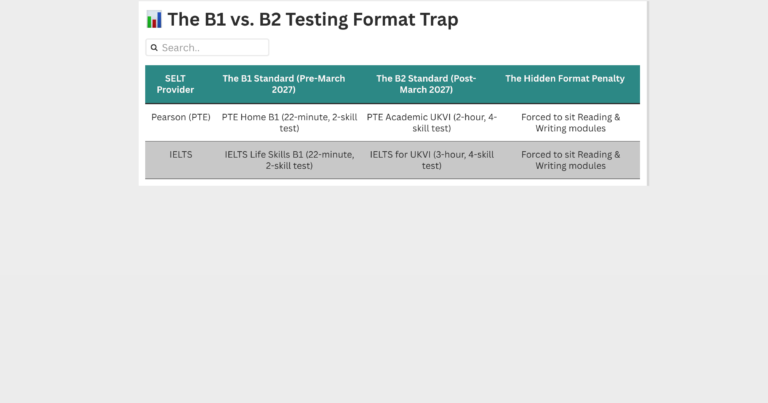
The financial math above only works if you successfully submit your ILR application the moment your qualifying window opens. A separate, hard deadline threatens to override salary achievements entirely. The Home Office is raising the English language requirement for permanent settlement from CEFR Level B1 to Level B2 for all applications submitted on or after March 26, 2027. Unlike the Earned Settlement framework itself, this change is already confirmed through HC 1691 and will take effect on that fixed date regardless of where the broader consultation ends up.
📊 The certification trap
The chart above models the strict logistical windows applicants need to navigate around this deadline. A Secure English Language Test certificate expires after exactly two years, which means testing early is not automatically the safe choice. The B1 testing window, running from October 1, 2026 through March 25, 2027, is the period during which applicants can still lock in the easier B1 standard before the rule changes — and as of the date of this post, that window has only just opened. From March 26, 2027 onward, every new application requires B2 proficiency regardless of when the applicant’s underlying ILR eligibility period began.
The SELT expiration danger zone, running from March 26, 2027 through late 2028 in this model, is where the real risk concentrates: tests taken too early, in a rush to beat the B1 cutoff, can expire before an applicant’s actual 10-year or accelerated qualifying window opens. If your qualifying window opens in early 2027, securing B1 certification promptly makes sense. If your window opens later in 2027 or into 2028, testing for B1 now risks the certificate expiring before you can use it, and preparing directly for B2 may be the more reliable path.
The consequence of missing the submission window, whether from a failed B2 exam or an expired SELT certificate, is not a paperwork inconvenience. Your current visa lapses, forcing an expensive extension application that locks you into another Immigration Health Surcharge cycle and effectively cements your timeline on the 10-year baseline regardless of your salary history.
🛑 4. The threat of negative adjustments
The proposed algorithm penalises financial vulnerability as aggressively as it rewards high earning. Relying on public funds for under 12 months adds a 5-year penalty to the qualifying timeline. Relying on them for over 12 months adds a 10-year penalty. A history of overstaying or illegal entry can add up to 20 years, functioning as an effective lifetime bar on settlement under the proposed rules.
Advantages and disadvantages of the proposed framework
✅ Advantages
- The 3-year acceleration. High-earning tech executives and founders can secure ILR significantly faster than the legacy 5-year system ever offered, bypassing years of visa renewal cycles entirely.
- Clear financial targets. The framework replaces subjective settlement criteria with absolute, mathematical thresholds based on documented P60 taxable income.
⚠️ Disadvantages
- The IHS fee trap. At £1,035 per year, a worker forced onto the 10-year baseline pays an additional £5,175 in surcharge fees alone before qualifying, on top of every other cost difference.
- Not yet law. Because the framework remains in consultation, tech workers are effectively planning multi-year tax and salary strategy around legislation that hasn’t received royal assent, and the final terms could still shift before implementation.
🎯 Right for & 🚫 wrong for
Right for: ambitious tech professionals who actively manage their compensation structure, prioritise taxable salary over fringe benefits, and track their P60 against the proposed £50,270 and £125,140 thresholds as explicit, concrete targets.
Wrong for: startup employees accepting low base salaries in exchange for substantial equity. Illiquid equity doesn’t count toward the taxable income threshold, which risks leaving genuinely high-net-worth employees stuck on the 10-year baseline despite real paper wealth.
Our recommendation
Treat the Earned Settlement proposals as an imminent reality rather than a distant possibility. Audit your most recent payslips and your company’s salary sacrifice offerings now. If your gross salary sits near £49,000, start the conversation with HR about pushing your taxable base salary comfortably above £50,270 to lock in eligibility for the proposed 5-year reduction. Separately, and regardless of how the consultation resolves, map your English testing timeline against the confirmed March 26, 2027 B2 deadline — that part of this picture is settled law, not a proposal, and it can derail an otherwise perfectly planned salary strategy if left until the last minute.
🖇️ Helpful links
- The £50,270 Salary Threshold: how salary sacrifice schemes can accidentally void your ILR reduction.
- £125,140 for a 3-Year ILR: why hitting the executive tier traps you in a 60% marginal tax bracket.
📚 Official Sources & Data Verification (2026)
All details regarding the Earned Settlement framework are based on the latest 2026 UK Government consultation proposals and parliamentary reports:
- Legislative Status: The Earned Settlement model is currently a proposed framework aiming for implementation by late 2026, and is not yet enacted law.
- The 10-Year Baseline: The proposal increases the default qualifying residence period for settlement from 5 years to 10 years for most applicants.
- Time Adjustments: The proposed framework applies offsetting adjustments, allowing a 5-year reduction for maintaining a £50,270 salary, or a 7-year reduction for maintaining a £125,140 salary over 3 consecutive years.
Frequently asked questions
Is the 10-year Earned Settlement rule officially enacted law?
No. The Earned Settlement model is a proposed policy framework that has closed a public consultation period. The final policy position and exact implementation date are still pending.
Do these proposed changes affect the Global Talent visa?
Under the current proposals, existing fast-track routes like the Global Talent visa, which already offers a 3-year settlement path, are generally exempt from the 10-year default baseline increase.
Can I combine reductions to get ILR even faster?
No. The consultation explicitly states reductions cannot be combined. Only the single largest reduction an applicant qualifies for applies against the 10-year baseline.