UK Indefinite Leave to Remain: decoding the 10-year continuous residence rules in 2026
For tech professionals who haven’t secured the £50,270 or £125,140 high-earner fast-tracks, the Home Office mandates a 10-year continuous residence qualifying period for Indefinite Leave to Remain. On April 11, 2024, the government abolished the old paragraph 276B rules and replaced them with Appendix Long Residence. In 2026, navigating this 10-year pathway means mastering a dual-track system of absence calculations that tracks every day spent outside the UK, with the two halves of your qualifying period governed by entirely different rules.
A single administrative error, a late visa renewal, or a trip that pushes your travel history past the limit by a single day breaks your continuity and resets the clock.
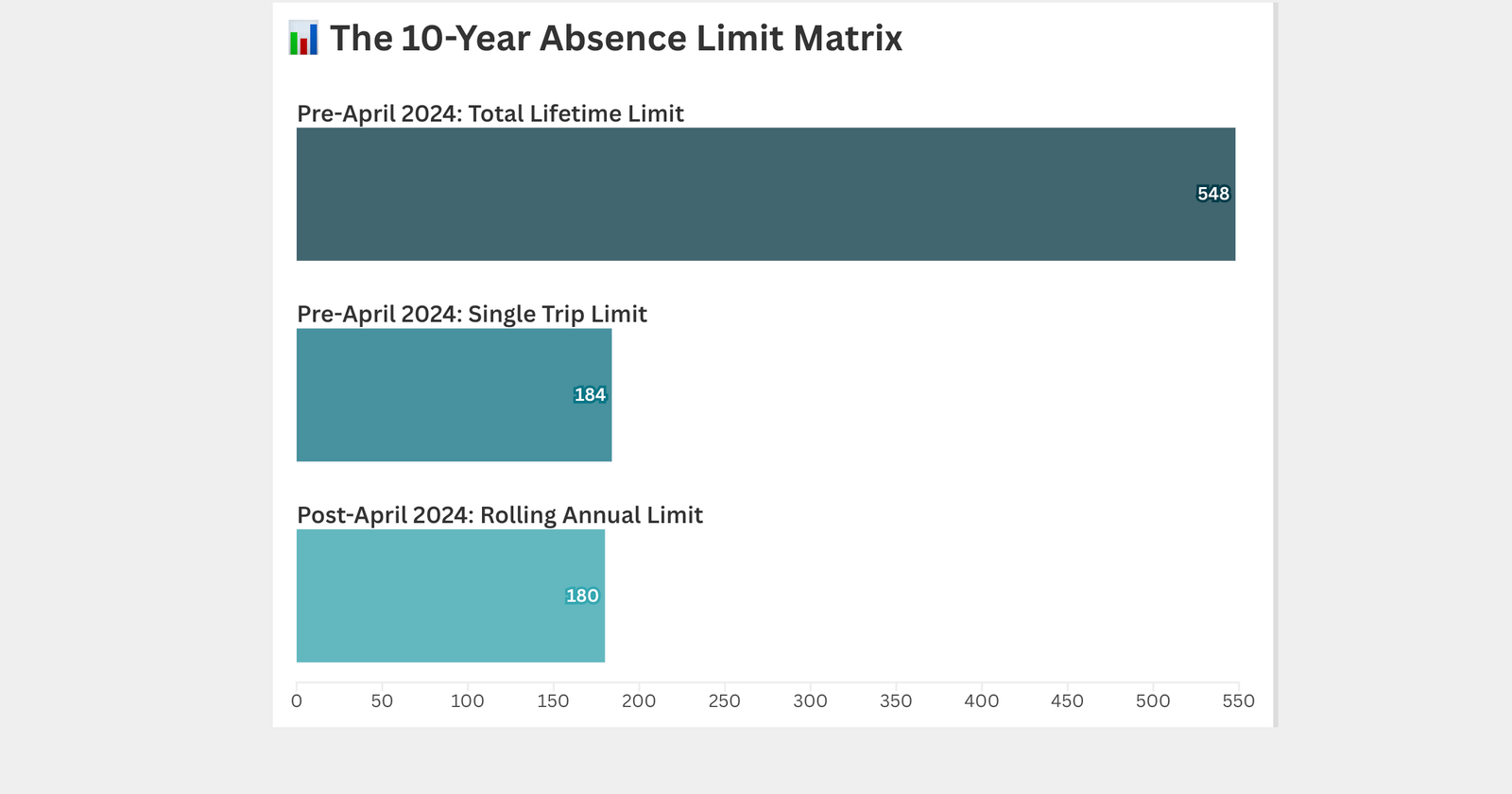
📊 Reading the 10-year absence limit matrix
The chart above shows three distinct thresholds, and the critical point is that they don’t combine into one running total. Pre-April 2024 travel is measured two ways at once: a total lifetime limit of 548 days across that entire portion of the qualifying period, and a single-trip limit of 184 days that no individual absence can exceed on its own. Post-April 2024 travel is measured differently: a rolling 180-day limit assessed over any 12-month window, with no lifetime cap at all for this portion.
The practical result is that your travel history before and after April 11, 2024 gets assessed under two separate rulebooks, and a caseworker checks both independently rather than adding everything into a single 10-year sum.
📉 1. The April 11, 2024 transition trap
If your 10-year ILR window closes in 2026 or 2027, your travel history straddles both sets of rules. Any trips taken before April 11, 2024 are assessed under the legacy limits: no more than 548 days outside the UK in total across that portion of the qualifying period, and no single absence exceeding 184 days. Breach either cap and the application gets refused, regardless of how clean the rest of the 10-year history looks.
🗓️ 2. The 180-day rolling window
For all travel from April 11, 2024 onward, the Home Office removed the 548-day lifetime cap entirely and replaced it with a rolling test. You cannot be outside the UK for more than 180 days in any rolling 12-month period, calculated by looking backward from every single day in the travel history, not by calendar year.
This catches combinations that wouldn’t look dangerous in isolation. A 100-day trip to India in December 2025 and a separate 90-day trip in March 2026 look like two reasonable absences on their own. But a 12-month window drawn backward from March 2026 captures both trips together, totalling 190 days and breaking continuous residence even though neither trip alone came close to the 180-day limit.
🛂 3. Electronic border tracking
UKVI caseworkers now have direct access to electronic border movement data. If the absent days declared on an ILR application don’t match the Home Office’s internal records, the application gets flagged immediately rather than processed on the applicant’s own account of their travel. Before submitting a 10-year route application, obtaining and auditing verified travel history directly from the government is worth doing before relying on personal memory or a spreadsheet built from memory of past trips.
Advantages and disadvantages of the 10-year pathway
✅ Advantages
- The aggregation rule. Unlike the standard 5-year Skilled Worker route, the 10-year long residence pathway allows combining time spent on multiple qualifying visas — student visas, graduate routes, sponsored work visas — provided there are no gaps in lawful status between them.
- Post-2024 flexibility for mobile professionals. Removing the 548-day lifetime cap for travel after April 2024 actually gives highly mobile tech workers more room, provided they police their 180-day rolling windows carefully.
⚠️ Disadvantages
- Zero forgiveness for status gaps. A gap between consecutive visas, however short, breaks the continuous lawful residence requirement outright.
- A full decade of cost and complexity. Maintaining legal status for ten years means a full decade of Immigration Health Surcharge payments and absence modelling that has to stay accurate the entire time.
🎯 Right for & 🚫 wrong for
Right for: professionals whose UK history includes extensive university study and graduate work before securing corporate sponsorship. The 10-year route captures those early years and counts them directly toward settlement, which the 5-year Skilled Worker route alone cannot do.
Wrong for: high-earning tech talent who qualify for the proposed 5-year or 3-year fast-tracks under the Earned Settlement framework. Enduring the full 10-year baseline when a faster, negotiable timeline is available is a significant and avoidable cost in both money and career flexibility.
Our recommendation
Don’t wait until year nine to audit travel history. If settlement on the 10-year continuous residence baseline is the plan, model absences across the pre- and post-April 11, 2024 divide now. Map every trip against the 548-day lifetime limit for older travel and the 180-day rolling window for newer travel separately, not as one combined total. If a historic gap in visa renewals has already broken continuity, it’s better to find out now and pivot toward a sponsored route than to discover it at the point of application.
🖇️ Helpful links
- 5-Year vs. 10-Year ILR: the exact financial penalty of falling onto the 10-year baseline and the March 2027 English deadline.
- The 2026 UK “Earned Settlement” Matrix: the proposed thresholds that let high earners buy back years lost to the 10-year default.
📚 Official Sources & Data Verification (2026)
All details regarding the 10-year continuous residence rules are verified against the UK Home Office’s 2026 Appendix Long Residence caseworker guidance:
- The April 2024 Overhaul: Appendix Long Residence replaced paragraph 276B of the Immigration Rules on April 11, 2024, fundamentally changing absence calculations.
- Pre-2024 Absences: Travel commencing prior to April 11, 2024, remains subject to a strict 548-day total absence cap and a 184-day single-absence cap.
- Post-2024 Absences: Travel commencing on or after April 11, 2024, is subject to a rolling limit of no more than 180 days absent within any 12-month period.
Frequently asked questions
Do I still need to pass the Life in the UK test for the 10-year route?
Yes. The 45-minute Life in the UK test and the CEFR B1 English requirement, which rises to B2 for applications from March 26, 2027, both remain mandatory before applying for settlement on this route.
Can I combine time spent on a Student Visa with my Skilled Worker Visa?
Yes. The 10-year long residence route allows aggregating time spent on any combination of qualifying visas, provided there were no gaps in lawful permission to remain between them.
Does time spent in the UK while waiting for a visa extension count?
Yes. Time covered by Section 3C of the Immigration Act 1971, which protects status while an in-time application or administrative review is pending, counts as lawful residence toward the qualifying period.